Synopsis
Completing hands-on physical therapy after knee, hip, or spinal surgery is a major milestone, but stopping rehabilitation as soon as acute clinical pain subsides leaves patients vulnerable to re-injury. Traditional physio sessions focus primarily on restoring basic range of motion and resolving surgical swelling, often leaving a significant gap before a patient is strong enough to resume daily active living. This guide explores the critical transition phase from treatment table manual care to active strength rebuilding. We examine how the integrated orthopaedic model at Orthocure Clinics and Strength Studios bridges this gap, allowing patients to safely step into a clinically supervised Medical Gym without risking surgical grafts, hardware, or fragile soft tissues. Guided by specialized physiotherapy, patients undergo targeted conditioning using MedX technology that features exact joint-axis alignment and range-of-motion limiters. Prioritizing structural correction during post-op loading ensures that your long-term movement patterns remain balanced, delivering lasting joint pain relief and protecting your surgical investment for life.
Table of Contents
- The Post-Surgical Plateau- Why Restoring Motion Is Only Half the Battle
- The Rehab Gap- The Danger of Jumping from Treatment Couch to Standard Gyms
- Bridging the Divide- What Is a Clinical Medical Gym Transition?
- The MedX Engineering Safety Net- Protecting Grafts, Hardware, and Cartilage
- Structural Correction- Aligning the Frame After Joint or Spine Surgery
- Specialized Physiotherapy- Continuous Doctor Supervision During Active Loading
- The Strength Studio- Rebuilding Dense Muscle Armor Around Surgical Sites
- Partnering with Orthocure to Safeguard Your Surgical Investment
The Post-Surgical Plateau- Why Restoring Motion Is Only Half the Battle
After undergoing a total knee replacement, ACL reconstruction, hip arthroplasty, or lumbar microdiscectomy, standard outpatient physical therapy focuses on initial recovery: reducing surgical inflammation, improving passive joint bending, and restoring a basic walking gait. However, once acute clinical pain calms down, insurance limits or standard treatment plans often discharge patients. At Orthocure Clinics and Strength Studios, we call this the “post-surgical plateau.” Your joint may be healed on paper, but the surrounding muscles remain severely atrophied, leaving you unprepared for real-world physical demands.
The Rehab Gap- The Danger of Jumping from Treatment Couch to Standard Gyms
Faced with muscle weakness after discharge, many patients attempt to rebuild their strength at a standard commercial gym. This creates a dangerous “rehab gap.” Commercial fitness machines are built with heavy starting weights, jerky pulley mechanisms, and unguided movement arcs that force compensating muscles to take over. Without clinical guidance, loading a freshly operated knee, hip, or spine in a commercial environment risks overloading healing tendons, loosening surgical hardware, or triggering severe inflammatory flare-ups.
Bridging the Divide- What Is a Clinical Medical Gym Transition?
A clinical Medical Gym transition serves as the vital bridge between passive table therapy and active physical strength. Rather than abruptly ending your care, your rehabilitation evolves smoothly into structured, doctor-guided resistance conditioning. In this specialized environment, every exercise machine is engineered as a clinical instrument, allowing you to build muscle density while keeping surgical tissues completely protected.
The MedX Engineering Safety Net- Protecting Grafts, Hardware, and Cartilage
The key to post-surgical safety in our Medical Gym is specialized MedX equipment. Featuring ultra-low internal friction, MedX machines provide accurate, extremely light starting loads that accommodate early-stage post-operative joint loading. Integrated range-of-motion limiters allow your clinician to restrict machine movement strictly to your safe, surgeon-approved bending angles. Furthermore, true joint-axis tracking prevents cartilage-grinding shear stress, ensuring your joint moves smoothly without friction.
Structural Correction- Aligning the Frame After Joint or Spine Surgery
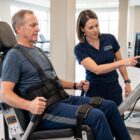
Surgical procedures alter your body’s mechanics, often causing sub-conscious posture compensations—such as leaning away from an operated hip or arching the lower back—that persist long after surgery. Structural correction at Orthocure focuses on correcting these functional deviations. By utilizing specialized body restraints, including pelvic locking straps, contoured back supports, and thigh pads, our equipment holds your skeleton in neutral alignment during exercise, preventing bad mechanical habits from taking root.
Specialized Physiotherapy- Continuous Doctor Supervision During Active Loading
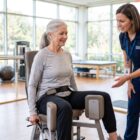
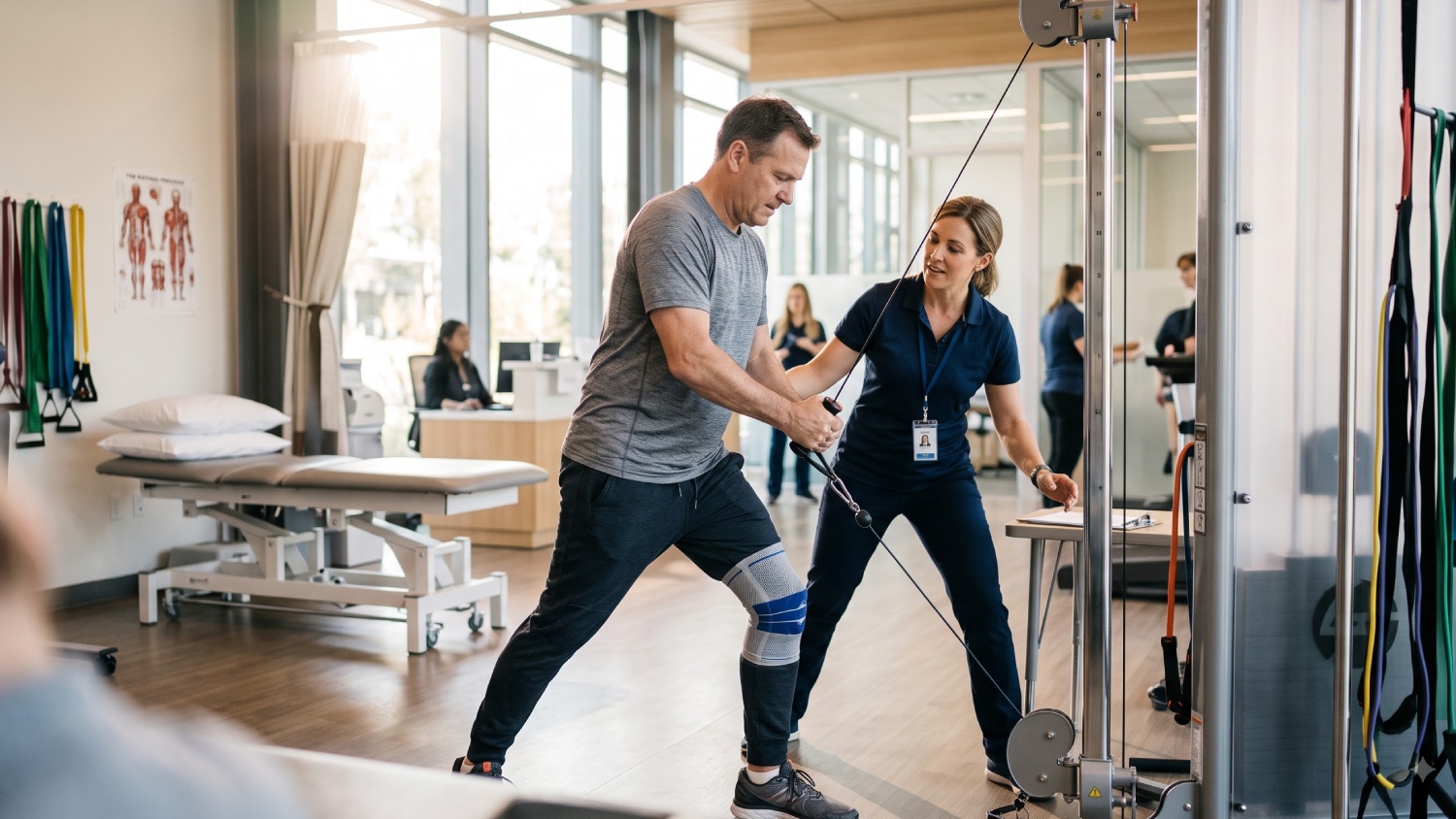
You are never expected to navigate post-operative strength building on your own. In our Medical Gym, every workout session is directly monitored by a Doctor of Physiotherapy. Our specialized physiotherapy team tracks your movement using built-in goniometers (angle detectors), monitors your tissue responses, and adjusts weights, seat angles, and range limiters in real time to ensure every rep actively advances your physical recovery.
The Strength Studio- Rebuilding Dense Muscle Armor Around Surgical Sites
Within our Strength Studio, isolated resistance loading rebuilds the quadriceps, hamstrings, gluteals, or spinal muscles that withered during post-op bed rest. Dedicated single-leg (unilateral) training allows us to address strength gaps between your operated and healthy limbs without letting the stronger side compensate. Rebuilding this muscular support matrix offloads the surgical joint, delivering lasting joint pain relief and restoring comfortable mobility.
Partnering with Orthocure to Safeguard Your Surgical Investment
Surgery is an investment in your future mobility, and post-operative conditioning determines its long-term success. By combining medical supervision, specialized MedX technology, and precise structural alignment, Orthocure Clinics and Strength Studios provides a safe, proven environment to transition from surgery to active living. Partner with Orthocure today and take the ultimate step toward full physical independence.
FAQs
When is it safe to transition from treatment table physical therapy to a Medical Gym program?
You can safely transition to our Medical Gym as soon as your surgical incisions have fully healed and your Doctor of Physiotherapy confirms that acute post-operative swelling is controlled. Because MedX equipment uses ultra-light starting weights and range limiters, strength rebuilding can begin early in recovery.
How does a Medical Gym prevent damage to my new surgical joint replacement or hardware?
Our MedX equipment is designed specifically to protect surgical sites. It uses true joint-axis tracking to eliminate cartilage shear, range-of-motion limiters set to your surgeon’s exact protocols, and full-body straps that prevent sudden twists or falls.
Why can't I just perform my post-surgery exercises at home using resistance bands?
Home resistance bands provide variable resistance that spikes unpredictably at the end of a stretch, and they do not isolate specific muscle groups effectively. MedX technology provides smooth, constant resistance that matches your muscle’s natural strength curve while isolating weak muscles without allowing compensation.
How does single-leg (unilateral) training help after knee or hip surgery?
After surgery, your body instinctively shifts weight onto your non-operated leg, causing significant strength loss in the operated limb. Unilateral training allows us to target and load the operated leg independently, ensuring it rebuilds equal strength without relying on the healthy side.
How long does a post-surgical medical strength program take to show results?
Most post-surgical patients notice improvements in walking confidence and daily joint stability within 2 to 4 weeks of starting guided MedX training. Rebuilding dense muscular armor in our Strength Studio and achieving lasting joint pain relief typically requires an 8-to-12-week clinical conditioning loop.