Synopsis
For decades, the “plank” has been hailed as the gold standard for core stability, yet many people with visible abdominal strength continue to suffer from chronic lower back pain. This guide examines the critical distinction between global core strength and the clinical isolation of deep spinal stabilizers. We detail why traditional floor exercises often allow dominant muscles like the hip flexors and rectus abdominis to “cheat,” leaving the spine unprotected. By utilizing MedX isolation technology at Orthocure Clinics and Strength Studios, patients can target the multifidus—the true guardian of the vertebrae. We examine how specialized physiotherapy identifies these “power leaks” in your core routine. Understanding that a six-pack does not equal a stable spine is the first step toward long-term back pain relief. Consistent training in our Strength Studio ensures that your core provides a genuine “natural brace” for your daily movements.
Table of Contents
- The Core Confusion- Why Your "Abs" Aren't Protecting Your Spine
- The Problem with Planks- When Global Muscles Take Over
- Meet the Multifidus- The Missing Link in Back Health
- MedX Isolation- The Science of Silencing the Cheaters
- Why Exercise Precision Trumps Volume in Core Rehab
- The Strength Studio- Building the Internal Brace
- Specialized Physiotherapy- Retraining the Brain-Muscle Connection
- Partnering with Orthocure for a Truly Stable Core
The Core Confusion- Why Your "Abs" Aren't Protecting Your Spine
Most fitness programs equate “core” with the rectus abdominis—the “six-pack” muscle. While these muscles are great for aesthetics and bending forward, they do almost nothing to stabilize the individual segments of your spine. At Orthocure Clinics and Strength Studios, we see patients who can hold a plank for three minutes but still experience a “catch” in their back when they lean over a sink. This is because their deep stabilizers are effectively dormant.
The Problem with Planks- When Global Muscles Take Over
The plank is a “global” exercise. When you hold a plank, your body naturally uses its strongest muscles to do the work—usually the hip flexors, quads, and outer abs. If your deep spinal muscles are weak, they simply “sit out” the exercise. This muscle compensation is a primary reason why generic core routines often fail to provide back pain relief . You aren’t strengthening your back; you’re just getting better at compensating.
Meet the Multifidus- The Missing Link in Back Health
The multifidus is a series of tiny muscles that wrap directly around the vertebrae. Their job is to keep the spine stable during movement. Research shows that in people with chronic back pain, the multifidus often “atrophies”—it literally turns into fat. Unlike the outer abs, you cannot see this muscle, and you cannot easily feel it working. Re-activating this muscle requires the high-level MedX isolation found in a clinical setting.
MedX Isolation- The Science of Silencing the Cheaters
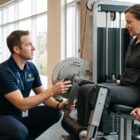
The breakthrough of MedX technology is its ability to “silence” the larger muscles. By using a patented pelvic restraint system, we lock the hips and legs out of the movement. This forces the deep spinal muscles to do 100% of the work. It is the only way to ensure that the “cheater” muscles aren’t taking over. This precision is what makes the Strength Studio experience fundamentally different from a standard gym workout.
Why Exercise Precision Trumps Volume in Core Rehab
In the Medical Gym , we don’t care how many reps you do; we care about which muscles are doing them. Specialized physiotherapy involves finding the exact angle and load where your spine is challenged but safe. By focusing on quality and isolation, we can achieve more in 15 minutes of MedX training than in months of unguided floor exercises.
The Strength Studio- Building the Internal Brace
The goal of our Strength Studio is to build your “natural brace.” When your deep stabilizers are strong, they create internal pressure that offloads the spinal discs. This acts like a hydraulic lift for your vertebrae, reducing the “pinching” and inflammation that cause pain. A strong core should be an automatic, 24/7 support system, not just something you “turn on” during a workout.
Specialized Physiotherapy- Retraining the Brain-Muscle Connection
Before we load the spine, our specialized physiotherapy team works on neuro-muscular re-education. We use tactile cues to help your brain “find” the muscles that have been switched off by pain. This “re-wiring” ensures that when you move into the strengthening phase, you are firing the correct fibers. It is the bridge between clinical rehab and functional power.
Partnering with Orthocure for a Truly Stable Core
Stop wasting time on core routines that don’t reach your spine. Our services at Orthocure Clinics and Strength Studios are designed to target the root cause of instability. By combining MedX isolation with medical expertise, we help you build a core that actually protects you. Partner with Orthocure today and feel the difference that true spinal stability can make in your life.
FAQs
If I have a six-pack, why is my back still hurting?
A six-pack (rectus abdominis) is designed for movement, not stability. If your deep stabilizers (like the multifidus) are weak, your spine is essentially unsupported, regardless of how your abs look. Our Strength Studio focuses on these “invisible” stabilizers to provide real back pain relief .
Is a plank bad for my back?
Planks aren’t “bad,” but they are often ineffective for rehab because the stronger muscles take over. If you have an active back injury, the compensation during a plank can actually increase the strain on your discs. MedX isolation is a much safer and more effective way to build stability.
How does MedX isolation feel compared to a normal gym machine?
It feels much more “intense” in a very specific, small area. Because you cannot use your legs or hips to help, you will feel muscles working deep in your back that you likely haven’t felt in years. This is the sign of successful spinal stability training.
How many sessions do I need to feel a difference in my core?
Most patients report feeling “sturdier” and more supported within 4 to 6 sessions. For permanent muscle growth and structural correction , a full 12-week protocol in our Medical Gym is recommended to ensure the results are durable.
Can I do MedX training if I currently have a disc bulge?
Yes, and it is often the best thing for it. By isolating the muscles, we can strengthen the “natural brace” around the bulge without the jerky movements that might aggravate it. Our specialized physiotherapy team will ensure the machine is set to a safe range of motion for your specific condition.