
Synopsis
Spinal stenosis is a progressive structural condition that can make a simple walk down the street feel like an uphill battle. Characterized by a gradual narrowing of the bony spaces within the spine, it puts a mechanical pinch on the spinal cord and exiting nerve roots. This guide explores the anatomical changes behind stenosis, focusing on the signature symptom known as neurogenic claudication—the dull, aching heaviness and cramping that spreads through the legs during upright walking. We detail how structural correction at Orthocure Clinics and Strength Studios alters the positional alignment of the lumbar spine to open up compressed nerve pathways. By shifting toward a clinically supervised Medical Gym approach, patients can safely build core endurance without jamming their spinal joints. We examine how specialized physiotherapy uses targeted flexion-based protocols and manual decompression to expand the spinal canal space. Understanding how to manage the physics of your spine is the first step toward lasting back pain relief and regaining your walking endurance. Consistent training in our Strength Studio ensures your muscles act as a strong, protective scaffolding, allowing you to walk further, stand longer, and live without constant limitations.
Table of Contents
- Inside the Narrow Canals- Understanding Lumbar Spinal Stenosis
- Neurogenic Claudication- Tracing the Cause of Heavy, Cramping Legs
- The Shopping Cart Sign- Why Bending Forward Brings Instant Relief
- The Extension Trap- How Standing Up Straight Pinches Your Nerve Roots
- Structural Correction- Maximizing Space in the Neural Tunnels
- Specialized Physiotherapy- Flexion Biomechanical Retraining
- The Strength Studio- Isolated MedX Training for Progressive Walking Endurance
- Partnering with Orthocure to Reclaim Your Daily Mobility
Inside the Narrow Canals- Understanding Lumbar Spinal Stenosis
Spinal stenosis refers to the structural narrowing of the central spinal canal or the lateral openings (foraminal spaces) where nerve roots exit the column. At Orthocure Clinics and Strength Studios, we educate our patients that this condition is typically a gradual byproduct of aging. Over decades, a combination of thinning spinal discs, thickening ligaments (ligamentum flavum), and the formation of bone spurs can encroach upon the delicate spaces reserved for your nerves. When these spaces shrink past a critical threshold, the nerves become physically compressed and starved of optimal blood flow.
Neurogenic Claudication- Tracing the Cause of Heavy, Cramping Legs
While stenosis occurs in the lower back, its most disruptive symptoms are felt below the waist. This clinical phenomenon is called neurogenic claudication. When you stand up and begin to walk, the mechanical demand on your lower spine increases. The compromised blood vessels inside the narrowed spinal canal cannot supply enough oxygen to the compressed nerve roots. This neural starvation manifests as a progressive, dull ache, numbness, burning, or a distinct “heavy, wooden leg” sensation that starts in the buttocks and creeps down into the calves.
The Shopping Cart Sign- Why Bending Forward Brings Instant Relief
Patients with spinal stenosis frequently discover a unique postural trick: they can walk through a grocery store for an hour without any leg pain as long as they are leaning forward over a shopping cart. In orthopaedics, this is known as the “Shopping Cart Sign.” Leaning forward naturally flexes the lumbar spine. This subtle forward bend physically widens the central spinal canal and lateral openings, instantly taking the mechanical pressure off the nerve roots and restoring local circulation. Achieving long-term back pain relief depends on replicating this spacious environment non-surgically.
The Extension Trap- How Standing Up Straight Pinches Your Nerve Roots
Conversely, standing completely upright or walking downhill forces the lower back into extension—an increased arch or a deeper pelvic tilt . This extension causes the bony structures of the spine to approximate, narrowing the internal canals even further. This is the “Extension Trap.” For a person with stenosis, forcing yourself to maintain a rigid, military-straight posture while walking acts like clamping a pair of pliers onto your nerve roots. True recovery requires entering a specialized Medical Gym to learn safe, flexion-biased movement strategies.
Structural Correction- Maximizing Space in the Neural Tunnels
Structural correction at Orthocure focuses on altering the functional resting position of your spine. We evaluate your pelvic and lumbar alignment to ensure your lower back isn’t locked into a state of hyper-extension. By utilizing gentle manual manipulations, pelvic de-rotation, and specialized mobility work, we help bias your pelvis into a neutral to slightly posterior position. This structural correction opens up the neural pathways, maximizing the physical space available for your nerve roots before you even take a step.
Specialized Physiotherapy- Flexion Biomechanical Retraining
Our specialized physiotherapy protocols are specifically tailored to avoid the aggressive extension movements that aggravate stenosis. We utilize targeted flexion-biased routines (such as Williams flexion exercises) to actively open up the posterior structures of the spine. Our physiotherapists employ advanced manual traction and soft-tissue mobilization to lengthen tight hip flexors and back extensors that pull the spine into a pinch. This hands-on care reduces localized inflammation and calms reactive muscle spasms.
The Strength Studio- Isolated MedX Training for Progressive Walking Endurance
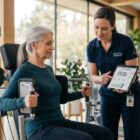
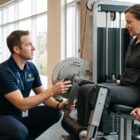
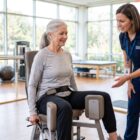
Once space is created within the spine, the core musculature must be conditioned to hold that spacious position effortlessly. In our Strength Studio , inside a safe and strictly monitored Medical Gym environment, we use specialized MedX technology to build extreme endurance in your abdominal wall and deep spinal stabilizers. By isolating and strengthening these specific muscle groups, we build a robust “muscular scaffold.” This clinical conditioning anchors your pelvis in a safe position, keeping the neural tunnels open and allowing you to progressively walk further without leg heaviness.
Partnering with Orthocure to Reclaim Your Daily Mobility
A diagnosis of spinal stenosis does not mean you are destined to lose your independence or face major decompression surgery. Our integrated services at Orthocure Clinics and Strength Studios provide a highly structured, non-surgical roadmap to expand your walking limits and protect your nervous system. By combining digital structural diagnostics, precise structural correction, specialized flexion therapy, and medical-grade resistance training, we help you overcome the physical bottlenecks holding you back. Partner with Orthocure today and step back into an active, mobile life.
FAQs
How can I distinguish between vascular issues and spinal stenosis leg pain?
Vascular claudication (poor blood circulation in the legs) and neurogenic claudication (spinal stenosis) both cause leg cramping during walking. However, vascular pain disappears quickly if you simply stop walking and stand still. Neurogenic claudication from spinal stenosis requires you to physically sit down or bend forward to widen the spinal canals before the leg heaviness goes away.
Is running or high-impact exercise safe for someone with spinal stenosis?
Generally, no. Running and high-impact sports place significant compressive shockwaves through the spine and often require a degree of lumbar extension, which can violently pinch the exiting nerve roots. In our Medical Gym , we replace high-impact conditioning with low-impact, highly isolated strength routines that build your walking endurance without jamming your joints.
Why do my legs feel completely normal when I am riding a bicycle?
When you ride a bicycle, your torso is naturally leaned forward over the handlebars, which places your lumbar spine into a rounded, flexed position. This position widens your spinal canal and completely offloads the nerve roots. Our specialized physiotherapy program works to translate this comfortable, open-spine environment into your upright walking gait.
Can an unlevel pelvis make spinal stenosis symptoms worse?
Absolutely. If your pelvis has an asymmetrical pelvic tilt , it forces the vertebrae to twist and tilt unevenly. This asymmetrical collapse further narrows the lateral tunnels on one side of your body, resulting in severe, one-sided leg pain and numbness. Achieving proper structural correction is essential to level the pelvis and balance the neural spaces.
How long does it take to see an increase in walking distance with clinical care?
Many patients experience a noticeable reduction in leg heaviness and immediate back pain relief within 3 to 4 weeks of starting targeted manual therapy and flexion retraining. Building the deep muscular endurance required in our Strength Studio to permanently hold the spine open and drastically extend your walking capacity typically requires an 8 to 12-week rehabilitation loop.