
Synopsis
Joint hypermobility—often casually referred to as being “double-jointed”—is a condition characterized by ligaments that stretch further than normal. While high flexibility is frequently praised in fitness and dance circles, it presents a unique set of mechanical vulnerabilities for the skeletal framework. This guide explores the physiology of joint laxity, explaining why stretching hypermobile joints can accelerate cartilage wear and trigger chronic muscle spasms. We detail how structural correction at Orthocure Clinics and Strength Studios focuses on stabilizing the hypermobile frame rather than increasing its range of motion. By shifting to a Medical Gym protocol, individuals learn to build a rigid “muscular corset” to compensate for their lax ligaments. We examine how specialized physiotherapy uses proprioceptive retraining to protect joints from micro-subluxations. Understanding that flexible bodies require deep mechanical control is the first step toward lasting joint pain relief. Consistent application of our targeted stabilization programs ensures that your hypermobile system remains strong, protected, and balanced.
Table of Contents
- The Hypermobility Paradox- When Flexibility Becomes Vulnerability
- Collagen and Laxity- The Science Behind "Double-Jointed" Tissues
- The Stretch Reflex Trap- Why Stretching Makes Your Tight Muscles Worse
- Micro-Instability- How Loose Ligaments Grind Joint Cartilage
- Structural Correction- Centering the Ball in the Socket
- Specialized Physiotherapy- Retraining Joint Position Sense
- The Strength Studio- Building the Muscular Armor for Loose Joints
- Partnering with Orthocure for a Stable and Powerful Future
The Hypermobility Paradox- When Flexibility Becomes Vulnerability
At Orthocure Clinics and Strength Studios, we frequently encounter patients who can easily touch their toes, bend their thumbs back to their forearms, or hyperextend their elbows. To the untrained eye, these individuals seem incredibly healthy and flexible. However, they are often suffering from widespread, migratory joint discomfort. This is the hypermobility paradox: a body that moves too much lacks the fundamental structural integrity to protect itself from everyday physical forces.
Collagen and Laxity- The Science Behind "Double-Jointed" Tissues
Joint stability relies on two systems: passive stabilizers (ligaments and joint capsules) and active stabilizers (muscles and tendons). In hypermobile individuals, the genetic makeup of their collagen produces tissue that is highly elastic. Because their ligaments stretch easily under tension, they fail to act as the natural “seatbelts” of the joints. Without this passive restraint, the body must rely entirely on its muscles to hold the bones in proper alignment.
The Stretch Reflex Trap- Why Stretching Makes Your Tight Muscles Worse
Hypermobile individuals often feel an intense, constant sensation of muscle tightness, especially in their neck, upper back, and hamstrings. This prompts them to stretch aggressively. However, this tightness is actually a protective muscle guarding mechanism. Because the ligaments are too loose, the brain commands the surrounding muscles to spasm in order to clamp down on the unstable joint. Stretching these muscles defeats their protective purpose, causing the brain to lock them up even tighter afterward. True joint pain relief comes from stability, not lengthening.
Micro-Instability- How Loose Ligaments Grind Joint Cartilage
When a joint lacks ligamentous restraint, the bones undergo subtle, repetitive shifting during movement, known as micro-instability. Instead of rotating cleanly on a fixed axis, the ball slides and grinds against the lip of the socket. Over time, this repetitive friction shears away the protective labrum or meniscus, leading to early-onset osteoarthritis and chronic, low-grade joint inflammation. Catching this pattern early through a specialized screening is essential for long-term joint preservation.
Structural Correction- Centering the Ball in the Socket
Structural correction for a hypermobile patient is highly specific. We do not look to open up joint space; instead, we look to compress and center the joint, a process known as joint centration. By evaluating your posture and mapping out where your body is resting at its extreme end-ranges, our clinicians use gentle adjustments and alignment strategies to bring your skeleton back into a neutral zone where the muscles can fire with maximal mechanical efficiency.
Specialized Physiotherapy- Retraining Joint Position Sense
Hypermobile individuals often have poor proprioception—their brain struggles to sense exactly where their joints are in space without looking at them. They frequently hyperextend their knees or slouch their spine without realizing it. Our specialized physiotherapy protocols utilize advanced balance drills, tactile biofeedback, and closed-kinetic-chain exercises. This precise neural retraining sharpens your joint position sense, teaching your body to automatically halt movement before reaching a dangerous hyper-extended zone.
The Strength Studio- Building the Muscular Armor for Loose Joints
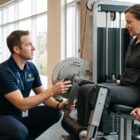
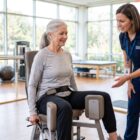
Because the ligaments cannot hold your frame together, your muscles must become your primary structural brace. In our Strength Studio , which features highly controlled training setups within a medical-grade Medical Gym environment, we eliminate ballistic, erratic movements. We utilize slow, deliberate, isometric and concentric resistance training to build exceptional muscle stiffness and tone. By creating dense “muscular armor” around your joints, we offload the lax ligaments and protect your cartilage from wear.
Partnering with Orthocure for a Stable and Powerful Future
If your body has a high range of motion, your primary goal must be to build a high level of control. Our integrated services at Orthocure Clinics and Strength Studios are designed to help hypermobile individuals move away from harmful stretching and toward clinical stabilization. By combining neurological retraining, structural correction, and precision muscle loading, we transform structural vulnerability into robust physical power. Partner with Orthocure today and anchor your body in strength.
FAQs
How do I know if I am truly hypermobile or just naturally flexible?
Clinicians use the Beighton Score to screen for systemic hypermobility. This involves checking if you can place your hands flat on the floor without bending your knees, hyperextend your elbows or knees past straight alignment, or pull your pinky finger back past 90 degrees. If you match several of these criteria and experience chronic, vague joint aches, you likely have joint laxity.
If my hamstrings feel constantly tight, shouldn't I stretch them?
If you are hypermobile, absolutely not. That “tight” sensation is your nervous system’s way of trying to stabilize your pelvis because your pelvic ligaments are loose. Stretching your hamstrings will only increase pelvic instability, forcing your lower back and hip muscles to spasm even harder to compensate. You need to strengthen your glutes and core instead.
Is heavy weightlifting safe for someone with hypermobile joints?
Weightlifting can be incredibly beneficial, but it must be done with flawless technique and strict range control. In our Strength Studio , we ensure that you never “lock out” your joints under load, as loading an hyperextended joint places massive, dangerous stress directly onto the bone and cartilage. We focus on training entirely within a safe, active mid-range of motion.
Can specialized physiotherapy cure joint hypermobility?
Hypermobility is a genetic trait concerning the structure of your collagen, so it cannot be “cured” or altered at a cellular level. However, its painful secondary symptoms can be entirely managed. Through specialized physiotherapy and targeted physical conditioning, you can make your muscles so strong and smart that your loose ligaments cease to cause pain or limitations.
How long does it take to build enough joint stability to stop the chronic aches?
Because neurological coordination adapts faster than muscle tissue grows, many patients notice a reduction in joint “clicking” and muscle spasms within 3 to 4 weeks of starting targeted proprioceptive training. Building structural muscle density to provide lasting joint protection typically takes a structured 8 to 12-week conditioning loop in our Medical Gym .