
Synopsis
Bone spurs, or osteophytes, are frequently misunderstood as rogue, painful growths that pierce surrounding tissues. This guide dismantles that myth, exploring the physiological reality of bone spurs as structural stabilization mechanisms deployed by the body in response to chronic joint friction and instability. We detail how structural correction at Orthocure Clinics and Strength Studios re-levels the skeletal framework to stop the progressive mechanical wear that drives bone spur formation. By utilizing a Medical Gym approach, patients can build targeted muscular support to offload compromised joints, rendering most bone spurs completely asymptomatic without the need for surgical removal. We examine how specialized physiotherapy restores smooth tissue gliding and capsule mobility around osteophytes. Understanding that smooth joint mechanics dictate your comfort is the first step toward lasting joint pain relief. Consistent training in our Strength Studio ensures your spine and limbs remain stable, balanced, and highly functional as you age.
Table of Contents
- The Osteophyte Myth- What a Bone Spur Actually Is
- Why the Body Grows Spurs- A Desperate Attempt at Stability
- The Common Friction Zones- Spine, Shoulders, Hips, and Heels
- The Real Source of Pain- When Spurs Pinch Nerves and Tendons
- Structural Correction- Stopping the Mechanical Wear Patterns
- Specialized Physiotherapy- Re-establishing Smooth Tissue Gliding
- The Strength Studio- Offloading the Skeleton with Muscular Armor
- Partnering with Orthocure for Lifelong, Smooth Joint Function
The Osteophyte Myth- What a Bone Spur Actually Is
When patients look at their X-rays and see a pointed growth on their vertebrae or joints, they often assume a sharp needle of bone is actively stabbing their muscles. At Orthocure Clinics and Strength Studios, we clarify that bone spurs, or osteophytes, are actually smooth, rounded mounds of excess bone tissue. They do not grow out of nowhere to cause harm; rather, they develop gradually over decades as a direct consequence of localized mechanical stress and cartilage thinning.
Why the Body Grows Spurs- A Desperate Attempt at Stability
To understand a bone spur, you must view it as the body’s natural defense mechanism. When a joint becomes unstable—due to poor posture, a previous ligament injury, or worn-down cartilage—the bones undergo excessive sliding and friction. In a desperate attempt to stabilize the joint and distribute the unphysiological load over a wider surface area, the body deposits fresh calcium along the edges of the bone. A bone spur is essentially the body trying to fuse or “brace” a loose, unstable joint.
The Common Friction Zones- Spine, Shoulders, Hips, and Heels
Osteophytes form wherever chronic friction resides. In the spine, they grow along the edges of the vertebrae as the intervertebral discs thin out, often leading to stiffness. In the shoulder, spurs can form on the underside of the acromion bone, directly narrowing the subacromial space. In the hips, they develop around the rim of the socket in response to an unlevel pelvis or a chronic pelvic tilt . On the heel, they grow at the attachment site of a chronically strained plantar fascia.
The Real Source of Pain- When Spurs Pinch Nerves and Tendons
A bone spur itself contains no nerve endings and is completely painless. Millions of adults have osteophytes and never know it. However, a bone spur becomes a problem when its size or location begins to compromise neighboring structures. In the neck or lower back, a spur can grow inward, narrowing the tiny exit tunnels of the spinal cord and pinching nerve roots. In the shoulder, it can scrape against the rotator cuff tendons, turning a stabilizing muscle into a source of chronic inflammation and driving the need for focused joint pain relief .
Structural Correction- Stopping the Mechanical Wear Patterns
Surgically shaving away a bone spur without changing your movement patterns is a short-sighted strategy; if the friction remains, the spur will simply grow back. Structural correction at Orthocure targets the mechanical wear patterns driving the growth. By realigning the spine, leveling the pelvic basin, and centering the joints in their optimal sockets, we immediately stop the abnormal rubbing. This structural correction halts the progression of the bone spur, protecting the remaining cartilage.
Specialized Physiotherapy- Re-establishing Smooth Tissue Gliding
Our specialized physiotherapy protocols focus on preserving the health of the soft tissues surrounding the osteophyte. When a bone spur is present, the nearby tendons and joint capsules tend to become stiff, fibrous, and chronically inflamed. Our physiotherapists use advanced manual therapy, joint distraction, and targeted myofascial release to restore smooth tissue gliding. This hands-on care eliminates the “catch” and pain associated with movement, proving that you can have smooth, pain-free mobility even with spurs present.
The Strength Studio- Offloading the Skeleton with Muscular Armor
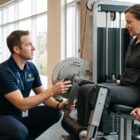
The ultimate solution to living comfortably with bone spurs is to build a highly active muscular suspension system. In our Strength Studio , inside a strictly monitored Medical Gym environment, we utilize medical-grade technology to isolate and strengthen the core and joint stabilizers. By making the surrounding muscles incredibly strong and reactive, they absorb the shock of daily impacts, physically offloading the skeleton and preventing the bones from rubbing together.
Partnering with Orthocure for Lifelong, Smooth Joint Function
Aging does not have to mean a decline into stiff, painful joints. Our integrated services at Orthocure Clinics and Strength Studios offer a comprehensive, non-surgical roadmap to manage degenerative joint changes. By combining precision digital diagnostics, targeted structural correction, specialized physical therapy, and data-driven conditioning, we ensure your framework remains resilient and unhindered. Partner with Orthocure today and invest in a future of smooth, powerful, and pain-free movement.
FAQs
Can bone spurs be dissolved with specialized medication or diet?
No. A bone spur is solid bone tissue, and there are no medications, supplements, or diets that can safely dissolve or melt them away. However, you do not need to remove them to live pain-free. By using structural correction to stop the joint friction and reduce inflammation, the spur can remain entirely dormant and harmless.
How do I know if my back pain is from a bone spur or a muscle strain?
A muscle strain typically presents as a broad, dull ache that improves with a few days of rest and gentle movement. A bone spur that is impinging on a spinal nerve root usually causes sharp, localized stiffness combined with radiating symptoms, such as shooting pain, numbness, or tingling traveling down your arm or leg (sciatica).
Why are my bone spurs worse in the morning?
When you sleep, your joints are static, causing localized circulation to slow down and the inflammatory fluids surrounding an active bone spur to pool. This creates significant morning stiffness. Our specialized physiotherapy incorporates specific mobility routines that stimulate synovial fluid production to flush out these inflammatory markers quickly.
Will exercising in a regular gym make my bone spurs worse?
It can if you use poor mechanics. Ballistic movements, heavy unsupervised lifting, or running on compressed joints can increase joint friction, accelerating cartilage wear and triggering bone spur growth. Training in our Medical Gym provides an isolated, low-impact environment where you can safely strengthen your muscles without jamming the joint surfaces.
Is surgery ever truly necessary for bone spurs?
Surgery is generally considered a last resort, reserved for severe cases where a massive bone spur is directly compressing the spinal cord, causing progressive muscle weakness, a loss of balance, or unmanageable nerve damage. Over 90% of symptomatic bone spur cases can be successfully managed non-surgically through the strength and alignment protocols in our Strength Studio .