Synopsis
Golf is often perceived as a low-impact sport, but the explosive rotation required during a swing places immense mechanical stress on the human frame. This guide explores the “Kinetic Chain of a Golf Swing,” mapping how energy transfers from the feet through the hips to the upper body. We detail why stiff, immobile hips force the lumbar spine to hyper-rotate—a dangerous compensation that dramatically accelerates disc degeneration and facet joint wear. By utilizing structural correction at Orthocure Clinics and Strength Studios, we help golfers restore true independent mobility in their hip joints. Through our data-driven Medical Gym approach, players learn to isolate their core and gluteal stabilizers, shifting the rotational load away from their lower back. We examine how specialized physiotherapy uses advanced manual mobilization to break down joint restrictions. Understanding this foot-to-hip mechanical pathway is the first step toward lasting back pain relief and a more powerful, repeatable swing.
Table of Contents
- The Rotary Explosion- Deconstructing the Biomechanics of a Swing
- The Hip Spine Dilemma- A Story of Mobility vs. Stability
- How Stiff Hips Force the Lumbar Spine to "Cheat"
- The Crunch Factor- Accelerated Disc Wear and Facet Jamming
- Structural Correction- Realigning the Pelvic Base
- Specialized Physiotherapy- Restoring Independent Joint Gliding
- The Strength Studio- Safe Isolation and Gluteal Power Development
- Partnering with Orthocure for Pain-Free Performance on the Course
The Rotary Explosion- Deconstructing the Biomechanics of a Swing
A successful golf swing is a marvel of the kinetic chain. Energy is generated from the ground, travels up through the legs, multiplies in the hips and torso, and accelerates out through the arms into the club head. At Orthocure Clinics and Strength Studios, we analyze this complex movement pattern to protect our players. If any single link in this chain is stiff or weak, the energy cannot flow smoothly. Instead, it pools in the nearest vulnerable structure—most commonly, the lower back.
The Hip Spine Dilemma- A Story of Mobility vs. Stability
In human anatomy, joints alternate in function. The hip joint is built for high mobility; it is a deep ball-and-socket designed to rotate smoothly in all directions. Conversely, the lumbar spine (lower back) is built for stability; its interlocking facet joints allow for bending forward and backward but offer less than 15 degrees of total rotation. For a clean, powerful swing, your hips must provide the twist while your lower back remains an unyielding pillar of support.
How Stiff Hips Force the Lumbar Spine to "Cheat"
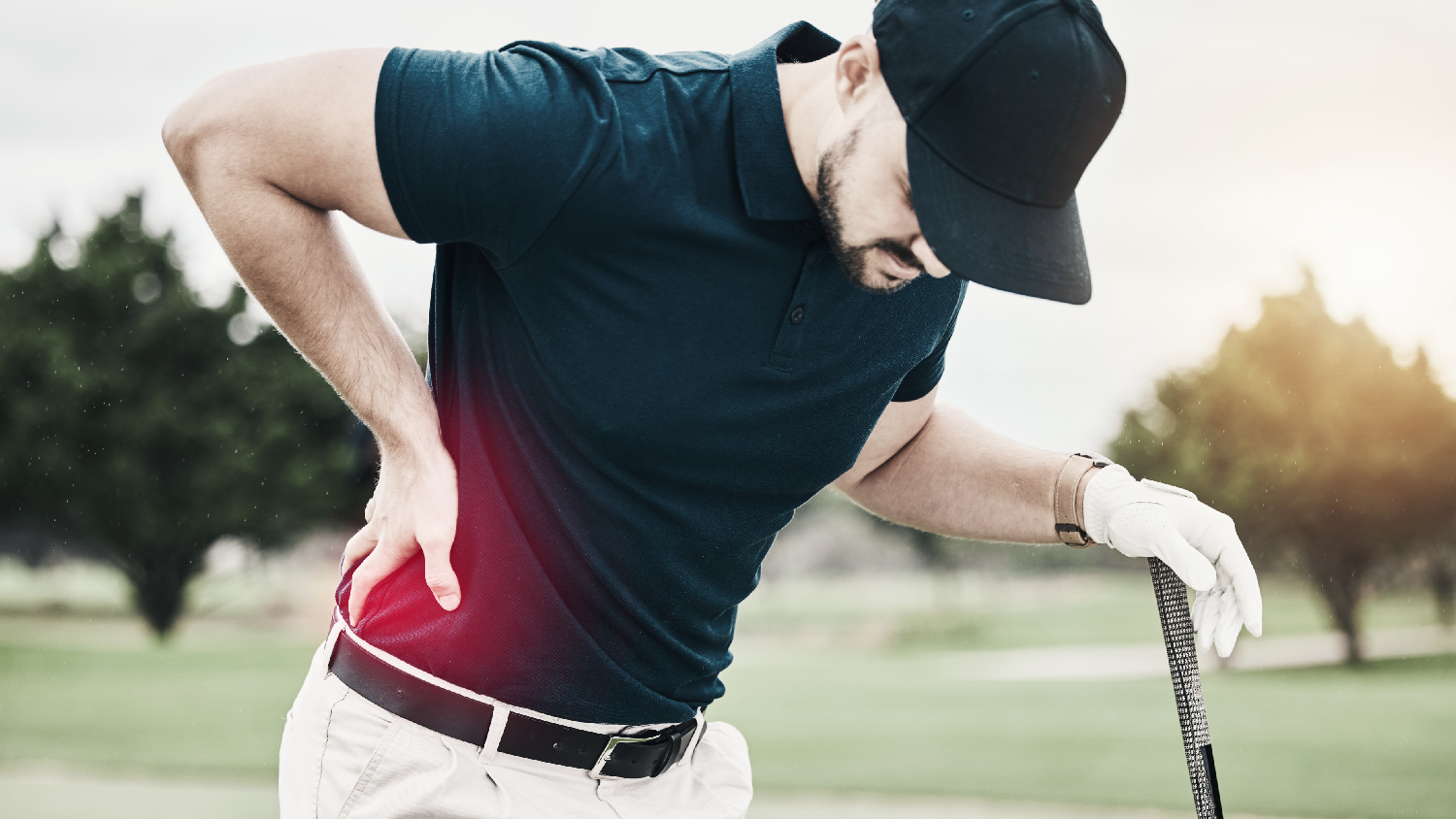
When a golfer develops stiff hips—often from long hours of desk work or age-related capsule tightness—the backswing and follow-through are severely compromised. Because the brain still wants to complete a full swing, it forces the stable lumbar spine to hyper-rotate to make up for the missing range of motion. This mechanical “cheating” is the primary driver of golfer’s back pain. You aren’t hurting your back because you swing hard; you are hurting your back because your hips are locked.
The Crunch Factor- Accelerated Disc Wear and Facet Jamming
Forcing the lower back to rotate while under the massive compressive loads of a golf swing creates a “crunch factor.” This unnatural twisting motion stretches the outer fibers of the lumbar discs, leading to micro-tears and eventual herniations. Simultaneously, it causes the facet joints in the back of the spine to violently jam into one another. Seeking back pain relief without opening up the hips means you are simply treating the symptom while ignoring the mechanical friction destroying your joints.
Structural Correction- Realigning the Pelvic Base
Structural correction at Orthocure begins with a comprehensive pelvic and spinal alignment assessment. If your pelvis is rotated or has an exaggerated anterior pelvic tilt , your hip sockets are placed at a severe mechanical disadvantage, locking up before you can achieve a full backswing. By correcting these underlying skeletal asymmetries, we level your foundation and instantly clear the path for safer, deeper hip rotation.
Specialized Physiotherapy- Restoring Independent Joint Gliding
Our specialized physiotherapy protocols target the dense, stubborn capsular tightness surrounding the hip joint. We utilize advanced manual joint mobilizations, soft-tissue release of the deep rotators, and targeted dynamic stretching. This hands-on care physically “unlocks” the ball-and-socket mechanism. Once the hip joint can glide independently again, the reflexive muscle guarding around your lower back naturally melts away.
The Strength Studio- Safe Isolation and Gluteal Power Development
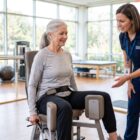
Once mobility is restored, we reinforce the kinetic chain in our Strength Studio . Using the highly controlled, medical-grade equipment in our Medical Gym , we isolate and strengthen your glutes, obliques, and deep spinal stabilizers. We build a powerful muscular corset that locks your lower back in place, forcing your newly liberated hips to drive the rotation. This clinical conditioning adds yards to your drive while shielding your spine from harm.
Partnering with Orthocure for Pain-Free Performance on the Course
Do not let chronic stiffness ruin your passion for the game. Our integrated services at Orthocure Clinics and Strength Studios are specifically engineered to optimize your body’s mechanical efficiency. By combining targeted medical diagnostics, precise structural correction, and golf-specific strengthening, we help you break the cycle of pain and unlock your true physical potential. Partner with Orthocure today and step back onto the tee with power, precision, and zero hesitation.
FAQs
Why does my lower back only hurt after playing a round of golf?
During the game, your adrenaline is high, which often masks micro-trauma. As you sit in the car or rest at home, the inflamed facet joints and strained muscles of your lower back begin to tighten and swell. This delayed pain is a clear warning sign that your spine is overworking to compensate for poor hip mobility.
Can I fix my hip stiffness by just stretching my hamstrings and hip flexors?
While stretching helps, true structural hip stiffness is often deep within the joint capsule itself. Passive stretching cannot easily stretch a thick joint capsule. It requires the precise, manual distraction techniques used in specialized physiotherapy alongside targeted loading in a Medical Gym to make a permanent change.
What is the easiest way to test if my hips are too stiff for golf?
Try a simple seated internal rotation test: sit tall on a hard chair with your knees at 90 degrees. Without moving your thighs apart or tilting your pelvis, try to swing your lower foot outward. If your foot barely moves away from the midline (less than 30 degrees), your hips are locked, and your lower back is absorbing the twist during your swing.
How does the Strength Studio protect a golfer's spine?
In our Strength Studio , we use advanced equipment to build extreme muscular endurance in your core and glutes. This ensures that even on the 18th hole when you are fatigued, your “natural brace” won’t fail. It forces your body to maintain a clean athletic posture, keeping the rotational stress entirely off your lumbar discs.
How long does it take to see improvements in my swing and pain levels?
Most golfers experience significant back pain relief and improved movement fluidity within 3 to 5 sessions as structural correction reduces immediate joint compression. A comprehensive 8 to 12-week protocol is recommended to permanently reprogram the kinetic chain and build lasting, explosive power.