
Synopsis
When attempting to stabilize the lower back, most rehabilitation programs focus strictly on structural muscle contractions. This guide explores the “Breathing-Core Connection,” exposing how your primary respiratory muscle—the diaphragm—directly regulates intra-abdominal pressure and lumbar stability. We detail how dysfunctional chest breathing patterns cause the diaphragm to remain elevated, leaving the lower spine vulnerable to micro-trauma and disc herniation. By utilizing structural correction at Orthocure Clinics and Strength Studios, we help patients realign their ribcage and pelvis to restore optimal respiratory mechanics. Through our advanced Medical Gym approach, individuals learn to coordinate their breathing cycle with mechanical loading, transforming their breath into a powerful stabilizer. We examine how specialized physiotherapy uses manual techniques to release a restricted diaphragm. Understanding that breathing is a foundational mechanical movement is the first step toward lasting back pain relief. Consistent training in our Strength Studio ensures that your core remains automatically pressurized and protected during every daily activity.
Table of Contents
- The Dual Role of the Diaphragm- Respiration and Spinal Stabilization
- The Core Canister- Understanding Intra-Abdominal Pressure
- How Paradoxical Chest Breathing Starves Your Spine of Support
- The Rib-Pelvis Alignment- The Foundation of Efficient Mechanics
- Structural Correction- Resetting the Core’s Structural Framework
- Specialized Physiotherapy- Releasing the Restricted Diaphragm
- The Strength Studio- Coordinating the Breath with Clinical Resistance
- Partnering with Orthocure for Deep, Pressurized Spine Protection
The Dual Role of the Diaphragm- Respiration and Spinal Stabilization
The diaphragm is universally known as the engine of respiration, but its second role as a major spinal stabilizer is frequently overlooked. This dome-shaped muscle sits at the base of the ribcage, separating the chest cavity from the abdomen. At Orthocure Clinics and Strength Studios, we educate our patients on how the diaphragm acts as the “lid” of their core system. When you inhale deeply, the diaphragm contracts and descends, creating a downward force that acts as the primary anchor for the lumbar spine.
The Core Canister- Understanding Intra-Abdominal Pressure
To understand how the breath protects your back, picture your abdomen as a sealed canister. The diaphragm is the top, the pelvic floor is the bottom, and the transverse abdominis wraps around the sides. When the diaphragm descends during a proper inhalation, it compresses the abdominal contents. This compression creates intra-abdominal pressure (IAP)—an internal hydraulic lift that pushes against the front of the vertebrae, dramatically reducing the compressive load on your lumbar discs.
How Paradoxical Chest Breathing Starves Your Spine of Support
Due to chronic stress, prolonged sitting, or poor postural habits, millions of individuals develop “paradoxical chest breathing.” Instead of the belly expanding during an inhale, the chest and shoulders shrug upward while the stomach pulls inward. This faulty pattern keeps the diaphragm stuck in an elevated, weak position. Without the downward descent of the diaphragm, your body cannot generate adequate IAP, forcing the passive ligaments and discs of your lower back to absorb all the mechanical stress of movement, driving the need for chronic back pain relief .
The Rib-Pelvis Alignment- The Foundation of Efficient Mechanics
For the diaphragm to create optimal pressure, it must sit directly opposite the pelvic floor, like two matching cymbals. If you have an exaggerated lower back arch, known as an anterior pelvic tilt , your ribcage flares open and your pelvis tilts forward. This structural misalignment pulls the diaphragm and pelvic floor out of parallel alignment, making it anatomically impossible to generate the internal pressure needed to stabilize your spine.
Structural Correction- Resetting the Core’s Structural Framework
Structural correction at Orthocure targets this rib-pelvis relationship. We evaluate your skeletal alignment to ensure that your thoracic cage sits squarely above your pelvic basin. By utilizing precise manual adjustments and skeletal mobilization, we bring your frame back into a neutral alignment. This structural correction instantly removes the mechanical strain on your respiratory muscles, allowing your core canister to function exactly as nature intended.
Specialized Physiotherapy- Releasing the Restricted Diaphragm
Our specialized physiotherapy protocols address the soft-tissue restrictions that lock up your breathing mechanics. When a patient has been chest-breathing for years, the diaphragm and surrounding intercostal muscles become tight and fibrotic. Our physiotherapists use advanced manual release techniques under the rib margin to physically relax the diaphragm. This hands-on release restores the muscle’s ability to glide downward, paving the way for deeper, more stable movement.
The Strength Studio- Coordinating the Breath with Clinical Resistance
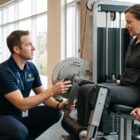
Once proper mechanics are restored, we lock in the pattern in our Strength Studio . Within our highly controlled Medical Gym environment, we teach you how to coordinate your breathing cycle with resistance training. You will learn to inhale and brace your core canister before initiating a movement, and exhale slowly through the most difficult phase of a lift. This deliberate coordination trains your nervous system to automatically protect your spine under heavy real-world loads.
Partnering with Orthocure for Deep, Pressurized Spine Protection
Every breath you take is either protecting your spine or placing it at risk. Our comprehensive services at Orthocure Clinics and Strength Studios provide the diagnostic clarity and physical retraining needed to fix your core from the inside out. By combining targeted structural correction, specialized soft-tissue therapy, and medical-grade core conditioning, we help you master the breathing-core connection. Partner with Orthocure today and breathe your way to a stronger, pain-free life.
FAQs
How can I test if I am a chest breather or a belly breather?
Place one hand flat on your chest and the other hand flat on your abdomen just above your belly button. Take a deep breath. If the hand on your chest moves upward first while the hand on your belly remains still or pulls inward, you are a chronic chest breather. Our specialized physiotherapy can help you retrain this pattern to protect your spine.
Why does my lower back feel stiff when I take a very deep breath?
If your diaphragm is tight and your ribcage is misaligned, a deep inhalation can cause your back muscles to over-contract to expand your lungs. This compensation puts immense pressure on your lumbar facet joints. Achieving proper structural correction ensures your ribs expand laterally without placing strain on your lower back.
What is intra-abdominal pressure, and why does my spine need it?
Intra-abdominal pressure (IAP) is the pressure generated inside your abdominal cavity by the coordination of your diaphragm, core wall, and pelvic floor. It works like an internal airbag; when pressurized, it physically supports the spinal column from the inside, significantly reducing the grinding forces on your lumbar discs.
Can I build a strong core by just doing standard sit-ups and crunches?
No. Traditional crunches only strengthen the superficial outer abdominal muscles, like the rectus abdominis. They do not train the diaphragm or the deep transverse abdominis to coordinate internal pressure. In fact, repetitive crunches can increase pressure downward onto a weak pelvic floor, destabilizing your core canister. True stability requires the targeted approach found in our Strength Studio .
How long does it take to fix a dysfunctional breathing pattern?
Because breathing is highly controlled by the subconscious nervous system, noticeable improvements in your muscle coordination and immediate back pain relief can be felt within 2 to 3 weeks of dedicated practice. Automating this habit so it remains effective under physical stress typically requires an 8 to 12-week progression in our Medical Gym .