
Synopsis
Many people wake up feeling as though their spine is “locked,” only to find the pain eases after an hour of moving around. This guide explores facet joint syndrome, a common but frequently overlooked condition where the small, stabilizing joints of the spine become inflamed or arthritic. We detail how structural correction at Orthocure Clinics and Strength Studios addresses the mechanical “jamming” of these joints caused by poor posture and repetitive strain. By shifting toward a Medical Gym approach, patients can strengthen the muscles that offload these delicate structures. We examine how specialized spinal physiotherapy uses manual mobilization to restore fluid movement to the posterior column of the spine. Understanding that morning stiffness is a mechanical warning sign is the first step toward long-term joint preservation. Consistent application of our integrated protocols ensures that your facet joints remain lubricated and your spine remains flexible throughout the day.
Table of Contents
- What Are Facet Joints- The Hinges of Your Spine
- Facet Joint Syndrome- When the Hinges Get Rusty
- The Morning Stiffness Mystery- Why You Feel Better After Moving
- Postural Triggers- How "Text Neck" and Pelvic Tilts Jam the Joints
- Structural Correction- Unlocking the Posterior Column
- Spinal Physiotherapy- Restoring Joint Gliding and Lubrication
- The Strength Studio- Building the Support System to Offload the Facets
- Partnering with Orthocure for Fluid and Pain-Free Movement
What Are Facet Joints- The Hinges of Your Spine
While the intervertebral discs sit in the front of your spine to absorb shock, the facet joints sit in the back (posterior). These pairs of small joints link your vertebrae together, allowing you to twist, bend, and lean. At Orthocure Clinics and Strength Studios, we describe them as the “hinges” of your back. When they are healthy, they glide smoothly; when they are irritated, every movement can feel like a chore.
Facet Joint Syndrome- When the Hinges Get Rusty
Facet joint syndrome occurs when the cartilage within these joints wears down or the joint capsule becomes inflamed. This is often the result of “over-extension”—where the spine is arched too much, causing the joints to rub against each other with excessive force. This leads to localized pain that can sometimes radiate into the buttocks or thighs, mimicking sciatica.
The Morning Stiffness Mystery- Why You Feel Better After Moving
A hallmark of facet joint issues is “morning stiffness.” During sleep, the joints lack movement, causing the inflammatory fluid to settle and the capsule to tighten. As you start moving, you stimulate the production of synovial fluid, which “greases the hinges.” However, relying on movement alone is just a temporary fix. Our Medical Gym protocols aim to fix the underlying mechanical reason why the joints are getting stuck in the first place.
Postural Triggers- How "Text Neck" and Pelvic Tilts Jam the Joints
Poor posture is the primary driver of facet pain. In the neck, “Text Neck” places the cervical facets under constant strain. In the lower back, an exaggerated anterior pelvic tilt forces the lumbar facet joints to “bottom out” or jam together. Structural correction is essential here to realign the spine so these joints have the space they need to glide without friction.
Structural Correction- Unlocking the Posterior Column
If your spine is structurally misaligned, the facet joints will continue to bear too much weight. Through a combination of chiropractic alignment and postural retraining, we “unlock” the posterior column. By moving the weight-bearing load back toward the discs and away from the sensitive facets, we provide immediate back pain relief and stop the cycle of inflammatory stiffness.
Spinal Physiotherapy- Restoring Joint Gliding and Lubrication
Specialized spinal physiotherapy for facet syndrome involves gentle joint mobilizations. Unlike a “crack,” these are rhythmic movements designed to restore the natural “glide” of the joint. This helps flush out inflammatory chemicals and brings fresh, nutrient-rich fluid into the joint space, allowing for much smoother movement throughout the day.
The Strength Studio- Building the Support System to Offload the Facets
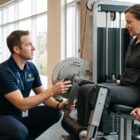
Once the joints are moving, we must protect them. In our Strength Studio , we focus on the muscles that control spinal extension and rotation. By strengthening the multifidus and abdominals, we create a “muscular cage” that prevents the spine from collapsing into the painful arched positions that irritate the facets. This is the ultimate goal of the Medical Gym —building a body that protects its own joints.
Partnering with Orthocure for Fluid and Pain-Free Movement
Don’t let morning stiffness dictate your day. Our services at Orthocure Clinics and Strength Studios are designed to identify the “stuck” hinges in your spine and restore their natural function. By combining structural correction with medical-grade strengthening, we help you move from stiffness to fluidity. Partner with Orthocure today and rediscover the joy of a flexible, powerful spine.
FAQs
Why does my back feel so stiff in the morning but better by noon?
This is a classic sign of facet joint syndrome. Inflammation builds up overnight while you are still. Moving around “greases” the joints with synovial fluid. However, if the morning stiffness returns every day, it means you have an underlying mechanical issue that needs structural correction
Can facet joint pain be mistaken for a disc bulge?
Yes, they can feel very similar. However, disc pain usually feels worse when bending forward, while facet joint pain feels worse when arching backward or twisting. Our integrated diagnostics at the Medical Gym help us pinpoint exactly which structure is causing your pain.
Is "cracking" my back the best way to fix facet syndrome?
While an adjustment can provide temporary relief by gapping the joints, it won’t fix the problem if your muscles are too weak to hold that alignment. That’s why we combine alignment with the Strength Studi—to ensure your facet joints stay in their healthy, “unlocked” position.
How does the Strength Studio help offload my facet joints?
By building the endurance of your deep spinal stabilizers (like the multifidus), we prevent your spine from “slumping” into positions that compress the facets. A Strength Studio session provides the muscular support needed to keep the weight on your discs and off your joints.
Are there specific exercises I should avoid with facet joint syndrome?
You should generally avoid heavy overhead lifting or deep backbends if your joints are currently inflamed. Our spinal physiotherapy team will guide you through a “joint-friendly” routine in our Medical Gym to build strength without aggravating the facet surfaces.